 Add to Chrome
 Add to Firefox
 Add to Edge
MindZero: Learning Online Mental Reasoning With Zero Annotations
May 29, 2026
Effective real-world assistance requires AI agents with robust Theory of Mind (ToM): inferring human mental states from their behavior. Despite recent advances, several key challenges remain, including (1) online inference with robust uncertainty updates over multiple hypotheses; (2) efficient reasoning suitable for real-time assistance; and (3) the lack of ground-truth mental state annotations in real-world domains. We address these challenges by introducing MindZero, a self-supervised reinforcement learning framework that trains multimodal large language models (MLLMs) for efficient and robust online mental reasoning. During training, the model is rewarded for generating mental state hypotheses that maximize the likelihood of observed actions estimated by a planner, similar to model-based ToM reasoning. This method thus eliminates the need for explicit mental state annotations. After training, MindZero internalizes model-based reasoning into fast single-pass inference. We evaluate MindZero against baselines across challenging mental reasoning and AI assistance tasks in gridworld and household domains. We found that LLMs alone are insufficient; model-based methods improve accuracy but are slow, costly, and limited by backbone MLLM capacity. In contrast, MindZero enhances MLLMs' intrinsic ToM ability and significantly outperforms model-based methods in both accuracy and efficiency, showing that mental reasoning can be effectively learned as a self-supervised skill.

CocoaBench: Evaluating Unified Digital Agents in the Wild
Apr 14, 2026LLM agents now perform strongly in software engineering, deep research, GUI automation, and various other applications, while recent agent scaffolds and models are increasingly integrating these capabilities into unified systems. Yet, most evaluations still test these capabilities in isolation, which leaves a gap for more diverse use cases that require agents to combine different capabilities. We introduce CocoaBench, a benchmark for unified digital agents built from human-designed, long-horizon tasks that require flexible composition of vision, search, and coding. Tasks are specified only by an instruction and an automatic evaluation function over the final output, enabling reliable and scalable evaluation across diverse agent infrastructures. We also present CocoaAgent, a lightweight shared scaffold for controlled comparison across model backbones. Experiments show that current agents remain far from reliable on CocoaBench, with the best evaluated system achieving only 45.1% success rate. Our analysis further points to substantial room for improvement in reasoning and planning, tool use and execution, and visual grounding.
AutoToM: Automated Bayesian Inverse Planning and Model Discovery for Open-ended Theory of Mind
Feb 21, 2025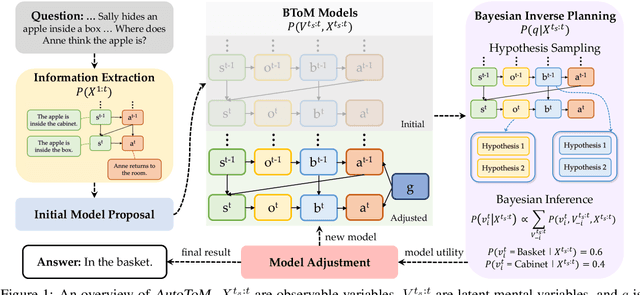
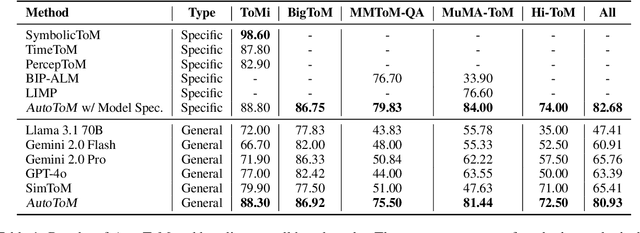
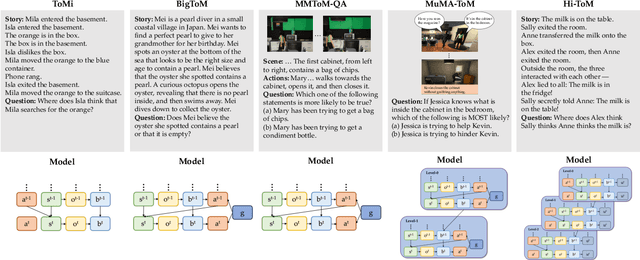
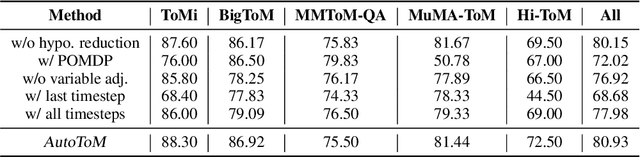
Theory of Mind (ToM), the ability to understand people's mental variables based on their behavior, is key to developing socially intelligent agents. Current approaches to Theory of Mind reasoning either rely on prompting Large Language Models (LLMs), which are prone to systematic errors, or use rigid, handcrafted Bayesian Theory of Mind (BToM) models, which are more robust but cannot generalize across different domains. In this work, we introduce AutoToM, an automated Bayesian Theory of Mind method for achieving open-ended machine Theory of Mind. AutoToM can operate in any domain, infer any mental variable, and conduct robust Theory of Mind reasoning of any order. Given a Theory of Mind inference problem, AutoToM first proposes an initial BToM model. It then conducts automated Bayesian inverse planning based on the proposed model, leveraging an LLM as the backend. Based on the uncertainty of the inference, it iteratively refines the model, by introducing additional mental variables and/or incorporating more timesteps in the context. Empirical evaluations across multiple Theory of Mind benchmarks demonstrate that AutoToM consistently achieves state-of-the-art performance, offering a scalable, robust, and interpretable approach to machine Theory of Mind.
Language Models Represent Beliefs of Self and Others
Feb 29, 2024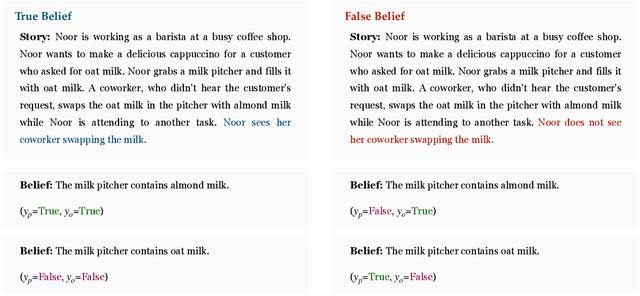
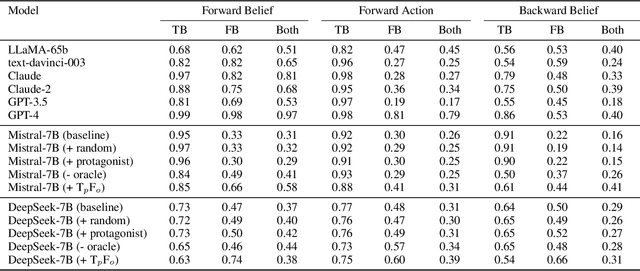
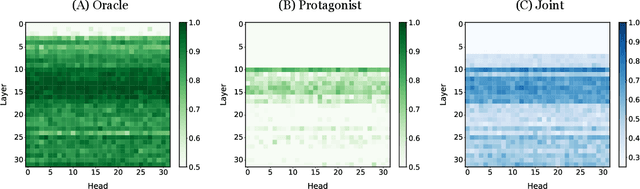
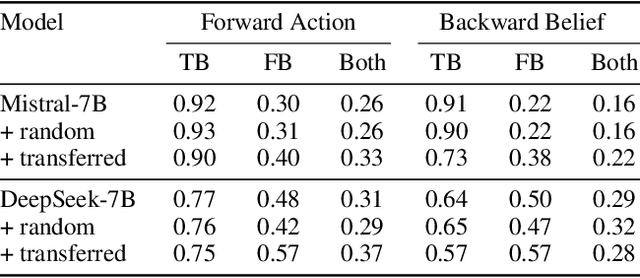
Understanding and attributing mental states, known as Theory of Mind (ToM), emerges as a fundamental capability for human social reasoning. While Large Language Models (LLMs) appear to possess certain ToM abilities, the mechanisms underlying these capabilities remain elusive. In this study, we discover that it is possible to linearly decode the belief status from the perspectives of various agents through neural activations of language models, indicating the existence of internal representations of self and others' beliefs. By manipulating these representations, we observe dramatic changes in the models' ToM performance, underscoring their pivotal role in the social reasoning process. Additionally, our findings extend to diverse social reasoning tasks that involve different causal inference patterns, suggesting the potential generalizability of these representations.